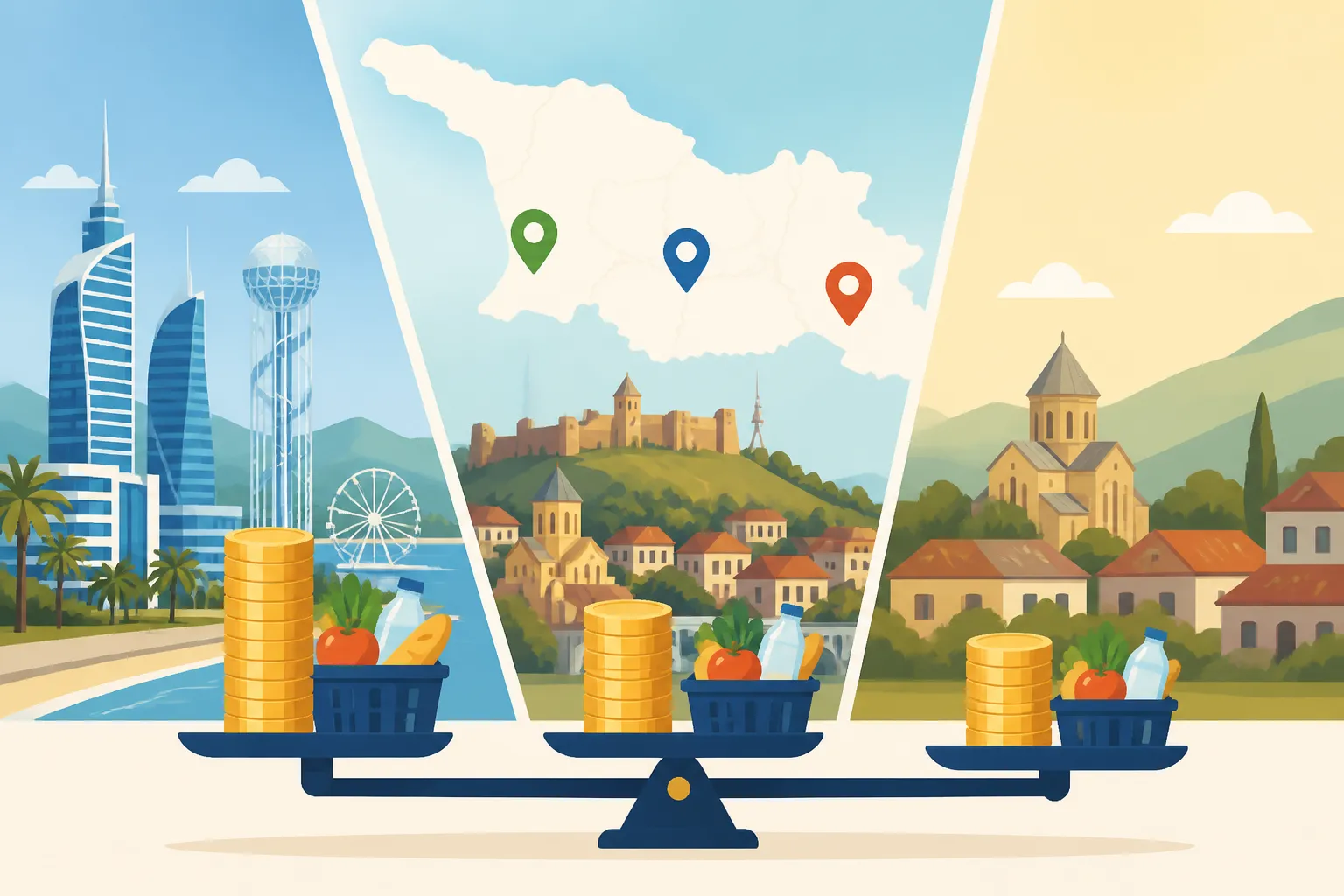
Understanding the Cost of Living Differences Across Georgian Cities
One of the trickiest parts of setting up a new life abroad is trying to pin down exactly what your monthly expenses will look like. You can scour forums, read countless articles, but until you're actually living it, those numbers often feel like moving targets. In Georgia, this is especially true because the cost of living can swing wildly depending on where you choose to drop your anchor. Don't worry, I've been there, staring at spreadsheets and trying to calculate how much I'd really need. This guide is going to walk you through the distinct financial landscapes of Georgia's main cities, helping you get a much clearer picture of what to expect.
The Big Three: Tbilisi, Batumi, and Kutaisi – An Overview
When you're thinking about moving to Georgia, chancesoften, three cities pop up in every conversation: Tbilisi, Batumi, and Kutaisi. Each has its own unique charm, lifestyle, and, crucially, cost structure. It's not just about the numbers; it's about the entire vibe and what you get for your money. Trying to compare them directly can be like comparing apples, oranges, and… well, maybe a khachapuri. They’re all delicious, but fundamentally different.
Tbilisi: The Capital's Premium
Ah, Tbilisi. The beating heart of Georgia, a city that effortlessly blends ancient history with a buzzing, modern cafe culture. It's vibrant, it's dynamic, and it's where most expats initially land. But let's be realistic: being the capital city, it naturally comes with the highest price tag. From housing to dining, and even some services, you'll feel the capital city premium in Tbilisi. It's the hub for international businesses, co-working spaces, and a truly diverse expat community, which contributes to the higher demand and, subsequently, higher costs.
Many of us who moved here years ago saw a very different, much more affordable Tbilisi. While it's still far from the prices you'd find in Western Europe or North America, the rapid influx of new residents and increasing popularity means that rents, especially, have soared. You'll find the widest range of options here, from swanky new builds in Vake or Saburtalo to charming, older apartments in Sololaki or Vera, but expect to pay more for convenience, modern amenities, and proximity to the expat hotspots. The trade-off is unparalleled access to everything: international schools, diverse cuisine, cultural events, and the best connectivity.
Batumi: Black Sea Charm with a Price Tag
Next up is Batumi, Georgia's "Pearl of the Black Sea." This city has undergone a truly remarkable transformation over the last decade, evolving into a glittering resort town with futuristic architecture, a stunning promenade, and a much more relaxed pace than Tbilisi. Many expats are drawn to Batumi for its sea breeze, its more compact size, and the promise of a resort lifestyle. However, don't be fooled into thinking it's a cheap alternative to Tbilisi, especially when it comes to housing.
Batumi's economy is heavily reliant on tourism and real estate development. This means that while some costs might be slightly lower than Tbilisi (groceries, for example), rent can actually be comparable, or even higher in prime beachfront locations, particularly for modern apartments in the new towers. The demand for short-term rentals, driven by tourists and investors, inflates the long-term rental market. During peak summer season, prices can skyrocket further. It’s definitely a beautiful place to live, especially if you love the sea and a more relaxed atmosphere, but be prepared for costs that often mirror or even exceed those in the capital for certain aspects of life.
Kutaisi: The Budget-Friendly Hub
If your budget is a primary concern, then Kutaisi, Georgia's legislative capital and the third-largest city, is probably going to be your most appealing option. It’s often overlooked by expats initially, but it offers a significantly lower cost of living across almost all categories compared to Tbilisi or Batumi. Kutaisi has a rich history, a charming old town, and is surrounded by stunning nature, including canyons and caves. It also boasts an international airport, making travel surprisingly convenient.
The pace of life here is slower, more traditional, and very much Georgian. While you won't find the same array of international restaurants or buzzing nightlife as in Tbilisi, you'll discover authentic Georgian hospitality and a genuine sense of community. Housing, groceries, and local services are considerably more affordable, making your hard-earned money stretch much further. For digital nomads or retirees looking for a peaceful, genuinely budget-friendly existence, Kutaisi often proves to be an excellent choice. The trade-off, of course, is fewer Western amenities and a smaller expat community, but for many, the cost savings and authentic experience more than make up for it.
Deep Dive into Core Expenses: Housing
Housing is almost always the biggest chunk of anyone's monthly budget, and in Georgia, it's where you'll see the most significant differences between cities. It’s not just about the rent itself, but also how much you’ll spend on utilities and any hidden costs. Having navigated the rental market myself in various parts of Georgia, I can tell you that understanding these nuances is crucial to avoid unexpected financial hits.
Rental Realities: Apartment Costs by City
Let's talk brass tacks about rentals. This is where most of us expats really feel the pinch, especially if you're coming from a country where rental prices are astronomically high. While Georgia generally offers more affordable options, the cities present stark contrasts.
In Tbilisi, for a decent one-bedroom apartment in a central, desirable area like Vake, Saburtalo, or Vera, you're likely looking at anywhere from $500 to $800 USD per month, sometimes more for a modern, well-furnished place. If you venture further out to districts like Didi Digomi or Gldani, you might find something for $300-$450, but then you're looking at longer commute times. For a two-bedroom, double those figures. The demand is consistently high, especially for quality, expat-friendly apartments with English-speaking landlords. It's always a good idea to research How Much Does It Cost to Rent an Apartment in Tbilisi in 2026? before you commit.
Batumi can be a real curveball. While some areas are cheaper, a modern, well-located one-bedroom apartment in one of the new developments near the promenade can easily cost $450-$700 USD, especially during peak season. Older apartments slightly further from the beach or boulevard might be found for $300-$400. The challenge here is the seasonal fluctuation; landlords might prefer short-term tourist rentals, making long-term options harder to find or more expensive. This dynamic can be frustrating for those seeking stable, year-round housing.
Now, Kutaisi is where your budget can breathe a sigh of relief. A comfortable one-bedroom apartment in a central area can often be secured for $200-$350 USD per month. Even two-bedroom apartments rarely exceed $450-$500, unless they are exceptionally modern or luxurious. The market here is much less saturated with speculative investment, leading to more stable and affordable prices. This significant difference in rent alone can free up a substantial portion of your income for other experiences or savings.
| Expense Category | Tbilisi (USD/month) | Batumi (USD/month) | Kutaisi (USD/month) |
|---|---|---|---|
| Rent (1-BR Central) | $500 – $800 | $450 – $700 | $200 – $350 |
| Utilities (Avg.) | $70 – $120 | $60 – $100 | $40 – $70 |
| Groceries (Single) | $200 – $300 | $180 – $280 | $150 – $220 |
| Public Transport | $10 – $20 | $8 – $15 | $5 – $10 |
| Dining Out (Mid-range) | $100 – $250 | $80 – $200 | $50 – $120 |
| Internet & Mobile | $25 – $40 | $20 – $35 | $15 – $30 |
| Fitness/Gym | $30 – $60 | $25 – $50 | $15 – $30 |
| Total (Est. Low End) | $945 | $853 | $475 |
| Total (Est. High End) | $1750 | $1580 | $830 |
Note: These are average estimates for a single person and can vary greatly based on lifestyle, negotiation skills, and specific choices.
When you're ready to dive into the rental market, a good first step is to check out The Complete Guide to Renting an Apartment in Georgia (2027). This will give you all the foundational knowledge you need to navigate the process, from contracts to deposits.
Utilities and Home Maintenance: What to Expect
Beyond the bare rent, utilities are your next major housing expense. In Georgia, these usually include electricity, natural gas (for heating and cooking), water, and sometimes communal building maintenance fees.
In Tbilisi, expect utility bills to range from $70 to $120 USD per month for a one-bedroom apartment, though this can climb much higher in the brutal winter months if you're using gas heating extensively. Old Soviet-era buildings often have less efficient heating, leading to higher bills. New builds, while perhaps costing more in rent, often have better insulation and modern heating systems, which can save you money on utilities. You’ll want to understand How Do I Set Up Electricity After Moving to Georgia? and also refer to The Expat Guide to Setting Up Utilities (Electricity, Water, Gas) in Georgia to get the full picture.
Batumi tends to have slightly lower utility costs than Tbilisi, partly due to a milder climate that reduces heating demands in winter. For a one-bedroom, you might pay $60 to $100 USD, again, with seasonal variations. However, some newer apartment towers in Batumi might have higher communal fees, especially if they offer amenities like pools or gyms.
In Kutaisi, utility bills are noticeably lower. For a comfortable one-bedroom, expect to pay around $40 to $70 USD per month. The heating systems are generally older, but the smaller apartment sizes and often less intense winters mean overall costs remain modest. You’ll find that everything from electricity to gas is simply priced lower here, reflecting the broader economic landscape of the region.
Overall, across all cities, if you're planning to stay for a while, it's worth understanding the specifics of your building's heating system and insulation. It can make a significant difference in your winter utility bills, which can sometimes be more than your rent in older, poorly insulated places!
Daily Life Costs: Food, Transport, and Leisure
After housing, your daily expenditures on food, getting around, and enjoying yourself make up the bulk of your budget. This is where your personal lifestyle choices truly come into play, but even here, the city you live in will influence your options and prices.
Grocery Shopping and Dining Out
Food is a universal need, but how you source it and where you eat can drastically alter your budget. Georgia is a food lover's paradise, but not all cities offer the same prices or variety.
In Tbilisi, you have the full spectrum. Local markets like Dezerter Bazaar offer fresh produce, meats, and cheeses at very reasonable prices, especially if you speak a little Georgian or Russian. Larger chain supermarkets like Carrefour or Goodwill offer a wider range of international products, but often at a premium. For a single person cooking at home, expect to spend $200-$300 USD on groceries per month. Dining out is also diverse; you can grab a delicious khachapuri for a few lari, or indulge in a fancy meal at a high-end restaurant for $50-$100+ per person. Mid-range restaurants are plentiful, where a meal with a drink might cost $15-$30. The sheer number of options means you can always find something to fit your budget.
Batumi offers a similar range, though perhaps with fewer high-end international dining options compared to Tbilisi. Groceries are often slightly cheaper in local markets, and supermarkets like Agrohub are also available. A monthly grocery bill for a single person might be $180-$280 USD. Dining out, especially for traditional Georgian food, can be very affordable, with meals at local eateries often costing $10-$20. However, prices for restaurants targeting tourists along the boulevard can be inflated, so choose wisely. Seafood, being a coastal city, is abundant and reasonably priced if you buy fresh from the market.
Kutaisi is definitely the most budget-friendly for food. Local markets are the primary source for fresh, seasonal produce, and prices are consistently lower than in the big cities. Supermarkets are present but generally smaller. A single person could easily manage on $150-$220 USD per month for groceries. Dining out is also very economical; a hearty traditional Georgian meal can be had for $8-$15 at most local restaurants. International cuisine is less common, but the focus on authentic local flavors means you'll eat well without breaking the bank.
Getting Around: Public Transport and Fuel
Navigating your chosen city is another key cost. Whether you rely on public transport, taxis, or your own car, prices differ.
Tbilisi boasts the most extensive public transport network, including a metro, buses, and marshrutkas (minibuses). A single ride on the metro or bus costs 1 GEL (approx. $0.37 USD), and you can buy a rechargeable Metromoney card for easy use. If you use it regularly, you might spend $10-$20 USD per month. Taxis are ubiquitous and affordable, with short rides across the city costing $2-$5 via apps like Bolt or Yandex Go. If you own a car, petrol prices are comparable across Georgia, but parking in Tbilisi can be a headache and sometimes costly. Remember, if you're considering driving, familiarise yourself with Driving in Georgia: Licences, Registration and Rules for Expats (2027).
Batumi also has a decent bus network, costing around 0.80 GEL per ride. Being a more compact city, many residents choose to walk or cycle, especially along the boulevard. Taxis are also readily available and cheap, typically $1-$4 for most inner-city journeys. The relatively flat terrain makes it very pedestrian-friendly, which can save you a lot on transport costs.
In Kutaisi, public transport mainly consists of buses and marshrutkas, which are very cheap (0.50-0.60 GEL per ride). The city center is walkable, and taxis are incredibly inexpensive, usually costing $1-$3 for most rides within the city. If you have a car, you'll find parking much easier and often free, unlike in parts of Tbilisi. Your transport budget here will be minimal, offering substantial savings compared to the larger cities.
Entertainment and Social Life
This is where your personal preferences really shine, but the availability and cost of activities still vary by city.
Tbilisi is the undisputed king of entertainment. From opera and ballet to live music venues, cinemas, art galleries, escape rooms, and a thriving nightlife scene, there's always something to do. A cinema ticket might be $7-$10, a concert ticket $15-$50+, and a night out at a popular bar could easily set you back $20-$50. There's also a huge array of cafes and co-working spaces. The expat community is large and active, offering countless social events, meetups, and language exchanges, many of which are free or low cost.
Batumi offers a more relaxed entertainment scene, heavily focused on its coastal attractions. The boulevard is a hub for cycling, jogging, and simply enjoying the sea views. During summer, there are often free concerts and events. Casinos are a major draw for some. You'll find a good selection of bars and cafes, though the nightlife isn't as intense or diverse as Tbilisi's. Cinema tickets are similar to Tbilisi. The social scene is more intimate, with a smaller but growing expat community.
Kutaisi provides a much quieter social life. There are local theaters, a few charming cafes, and traditional Georgian restaurants where live music might be played. Big-ticket concerts or international events are rare. Most entertainment revolves around enjoying the local culture, visiting nearby natural attractions, or socializing in smaller groups. A night out might consist of dinner and drinks at a local eatery, costing you perhaps $15-$25. The appeal here is the authenticity and the opportunity to truly immerse yourself in Georgian life, rather than a bustling international scene.
Other Essential Considerations for Expats
Beyond the day-to-day, expats have specific needs when it comes to healthcare, education for their children, and staying connected. These can be significant budget line items, and their availability and cost differ greatly across Georgia.
Healthcare and Insurance
Healthcare is a critical area for any expat. Georgia has a universal healthcare program, but for many expats, private health insurance is a must.
In Tbilisi, you'll find the widest selection of private clinics and hospitals, many with English-speaking staff and international standards. Companies like JSC Aldagi Insurance Company (a prominent local provider) offer a range of plans. A private doctor's visit might cost $20-$50 without insurance. Comprehensive private health insurance for a single person can range from $300-$800 USD per year, depending on coverage. The accessibility to specialist care and modern medical facilities is highest here, which often brings peace of mind. It’s absolutely essential to read up on The Complete Guide to Healthcare in Georgia for Expats (2027) before you move.
Batumi also has several modern private clinics and hospitals, although the range might be slightly less extensive than Tbilisi. You can still find English-speaking doctors, but it might take a bit more searching. Private insurance options are similar in price to Tbilisi, and a doctor's visit might be in the $20-$40 range. For very specialized treatments, you might still need to travel to Tbilisi.
Kutaisi has a more limited selection of private healthcare providers. While adequate for routine care, finding English-speaking doctors can be more challenging. Most expats in Kutaisi rely on local clinics for basic needs and travel to Tbilisi for more complex medical issues. Private insurance is still highly recommended, but the local facilities are less geared towards international patients. The cost of a basic doctor's visit would likely be $15-$30.
Remember, even with private insurance, it's wise to carry some cash or a card for immediate payments as reimbursements might take time.
Education for Expat Families
For expats with children, schooling is a significant factor in deciding where to live, and it carries substantial costs.
Tbilisi is the only city with a significant number of international schools offering curricula like the IB or British System. Schools like the QSI International School of Tbilisi or the British International School of Tbilisi are popular choices. Tuition fees are substantial, often ranging from $8,000 to $18,000+ USD per year per child, depending on the age and school. Public Georgian schools are free but operate entirely in Georgian, making them less feasible for non-Georgian-speaking expat children. There are also private Georgian schools that offer bilingual programs, often at a lower cost than international schools, typically from $2,000-$5,000 USD per year. If you have kids, understanding How Much Are International School Fees in Tbilisi? is vital.
Batumi has a much more limited selection. There might be one or two smaller international schools or schools offering international programs, but they are fewer and typically newer. Tuition fees would likely be similar to the lower end of Tbilisi's international schools, or slightly less. Many expat parents in Batumi opt for online schooling or local private Georgian schools if their children are learning Georgian.
Kutaisi essentially has no international schools. Expat families here typically choose online schooling or enroll their children in local Georgian public or private schools, often hiring private tutors for language support. This makes Kutaisi a very different proposition for families with school-aged children, as the educational landscape demands a different approach or a higher degree of independent learning.
Connectivity: Internet and Mobile
Staying connected is non-negotiable for modern life, and luckily, internet and mobile services in Georgia are generally affordable and reliable, regardless of the city.
In Tbilisi, you'll find excellent internet infrastructure with providers like Silknet and Magti offering fiber optic connections. For a home internet plan, expect to pay $20-$35 USD per month for good speeds. Mobile plans are also very competitive, with unlimited data options costing $10-$20 USD per month from providers like Magti, Geocell, or Beeline. You can easily get a SIM card upon arrival, or even use an eSIM from a provider like Airalo for immediate connectivity when you land, before sorting out a local plan. This city is a digital nomad's dream for connectivity. You can find more details on How Do I Set Up Internet in My Georgia Home?.
Batumi also has robust internet and mobile services, comparable to Tbilisi. Silknet and Magti are the main players. Home internet plans typically cost $18-$30 USD per month, and mobile plans are similar to Tbilisi prices. Connectivity is generally excellent, supporting remote work and streaming without issues.
Kutaisi offers slightly cheaper internet and mobile plans. Home internet might range from $15-$25 USD per month, and mobile packages are also on the lower end, around $8-$15 USD. While the speeds might not be quite as blazing fast as in the capital, they are perfectly sufficient for most needs, including remote work and video calls. The infrastructure has improved significantly over the years, ensuring reliable service.
Beyond the Major Cities: Exploring Regional Variations
While Tbilisi, Batumi, and Kutaisi capture most of the expat attention, Georgia is a country rich with smaller towns and stunning rural areas. These places offer an even deeper dive into authentic Georgian life and, predictably, even lower costs of living. However, they come with their own set of considerations and trade-offs.
Smaller Towns and Rural Living
Venturing out into smaller towns like Gori, Telavi, or Zugdidi, or even more rural villages, presents a dramatically different cost structure. Housing, for instance, becomes significantly cheaper. You could find a decent house to rent in a provincial town for $150-$300 USD per month, or even less for a smaller apartment. Property ownership is also much more accessible, making it an attractive option for those looking to buy land or a country home.
Groceries in these areas are often sourced directly from local farms and markets, leading to extremely low prices for fresh produce, meat, and dairy. Eating out would largely mean traditional Georgian fare at very modest local cafes. Public transport is minimal, mostly relying on marshrutkas connecting towns, or simply walking. Car ownership becomes more of a necessity in rural settings, but overall transport costs remain low due to less traffic and easier parking. The lifestyle is inherently simpler, slower, and deeply connected to local traditions. This can be a huge draw for those seeking an escape from urban hustle and a truly immersive experience.
The Trade-offs: Cost vs. Amenities
While the financial savings in smaller towns and rural areas are undeniable, it's crucial to acknowledge the trade-offs. The availability of modern amenities and services, which many expats take for granted, becomes severely limited.
Firstly, healthcare options dwindle rapidly outside the main cities. Specialist care and advanced medical facilities are rare, meaning you would almost certainly need to travel to Tbilisi or Batumi for anything beyond basic medical attention. This adds travel time, stress, and potentially higher costs to your healthcare needs. Education for children also poses a significant challenge, as international schools are non-existent, and even private Georgian schools are few and far between. This often necessitates homeschooling or a strong commitment to local public education, along with language immersion.
Secondly, the expat community will be tiny, if it exists at all. While this can force deeper integration into local life, it can also lead to feelings of isolation for some. English proficiency among locals decreases significantly, making daily interactions more challenging without a grasp of Georgian or Russian. Internet and mobile connectivity, while generally good across Georgia, might be slightly less reliable or slower in very remote areas. The selection of international products in stores will be almost non-existent, and dining options will be strictly traditional.
Ultimately, choosing a smaller town or rural area is a lifestyle decision that prioritizes authenticity and extreme affordability over the conveniences and diverse opportunities found in Georgia's larger cities. It's a path less traveled by many expats, but one that offers profound rewards for those willing to embrace the challenges.
Strategies for Managing Your Budget in Georgia
Alright, so we've broken down the costs. Now, how do you actually manage all this so you're not constantly stressing about your bank account? Living as an expat in Georgia, I’ve picked up a few tricks, some obvious, some less so. It's not just about cutting costs, but about making smart choices that fit your lifestyle and don't leave you feeling deprived.
Practical Tips for Cost Savings
Saving money in Georgia isn't about extreme minimalism, it's about being aware and making intentional choices.
First, embrace local markets for groceries. This is hands down the best way to save money on food. Forget the gleaming aisles of imported goods at Carrefour for your staples. Head to the local bazaars for fresh fruits, vegetables, cheeses, and meats. Not only are the prices significantly lower, but the quality is often superior, and you're supporting local farmers. Plus, it's a fantastic cultural experience!
Second, leverage public transport and walking. If you're in Tbilisi or Batumi, the public transport systems are efficient and incredibly cheap. Get a Metromoney card in Tbilisi and top it up. For short distances, walking is not only free but also a great way to explore the city and stay active. Taxis are cheap, but relying on Bolt for every short trip adds up over time. If you're moving your belongings to Georgia, consider using a service like Sirelo to compare quotes for international movers. Planning this well in advance can prevent costly last-minute shipping expenses.
Third, cook at home more often. While dining out is affordable, regularly eating at restaurants, even cheap ones, will always cost more than preparing your own meals. Get adventurous with Georgian recipes – they’re delicious and often use simple, fresh ingredients.
Fourth, be mindful of heating in winter. Georgian winters can be surprisingly cold, and heating bills can sneak up on you. Dress warmly indoors, use extra blankets, and if your apartment has central heating, try to be efficient with it. In some older buildings, people only heat one or two rooms. This is one of those expenses that can really bloat your budget if you're not careful.
Finally, negotiate rent and be wary of short-term rental prices. Especially in Batumi and even Tbilisi, some landlords try to push higher prices, particularly if they think you're a fresh-off-the-boat expat. Don't be afraid to negotiate, especially if you're looking for a long-term contract. Always compare prices across multiple listings and platforms.
Understanding the Local Economy
Understanding the Georgian economy helps you predict future cost changes and make informed decisions. Georgia's economy is growing, with a significant focus on tourism, services, and increasingly, IT and remote work. This growth, coupled with a relatively stable currency (GEL), generally keeps prices competitive. However, the influx of foreigners and increased demand in cities like Tbilisi and Batumi can drive up specific costs, especially for housing.
The low tax burden for individual entrepreneurs (often just 1% on turnover up to a certain threshold) means that many freelancers and small business owners can operate very cost-effectively here, which in turn contributes to the overall affordability of services. However, this also means that local wages are often lower than in Western countries, so if you're earning a local salary, the cost of living needs to be carefully managed.
The ongoing developments and investments in infrastructure, particularly in tourism and real estate, suggest that prices, especially for modern amenities and central locations, will likely continue to rise gradually in Tbilisi and Batumi. However, the more traditional and rural areas are likely to remain significantly more affordable, maintaining that distinct cost-of-living difference across the country. Keeping an eye on these trends helps you plan your long-term financial strategy and decide if Georgia truly fits your budget goals. Knowing How Much Does It Cost to Live in Georgia for Expats? in general will give you a baseline for these economic shifts.
Disclaimer
The information provided in this guide is for general informational purposes only and does not constitute financial, legal, or professional advice. While every effort has been made to ensure accuracy, costs, regulations, and availability can change rapidly. Expats should conduct their own thorough research and consult with appropriate professionals (e.g., financial advisors, legal experts, real estate agents) for personalized advice. We are not liable for any loss or damage arising from reliance on this information.