Understanding Emergency Numbers (112) and Ambulance Care in Georgia
Moving to a new country like Georgia is an adventure, full of exciting discoveries and new experiences. But let's be honest, the thought of a medical emergency happening in a place where the language, systems, and even the simple act of calling for help are different from what you know can be truly terrifying. That feeling of vulnerability is something every expat grapples with. This guide is here to cut through that anxiety, giving you a clear, empathetic, and realistic understanding of Georgia’s emergency number (112) and what to expect from ambulance care, so you can feel a little more prepared, just in case.
The All-Important 112: Your Lifeline in Georgia
When trouble strikes, whether it’s a medical emergency, a fire, or a crime, your first and most crucial step in Georgia is dialing 112. This isn't just an ambulance number; it's the unified emergency dispatch system for everything, a real one-stop shop for help. For many of us coming from countries with separate numbers for police, fire, and medical services, this integrated approach can be a bit of a mental shift, but it’s designed for efficiency.
What 112 Actually Covers
Think of 112 as Georgia's version of 911 or 999. It’s an integrated emergency service, meaning one call connects you to operators who can dispatch police, fire, and ambulance services simultaneously or individually, depending on the nature of your emergency. This integrated system is a huge advantage, especially in high-stress situations where every second counts. You don't have to waste precious moments trying to remember which number is for what. The operators are trained to triage your situation and get the right help headed your way.
What's really reassuring for expats is that 112 in Georgia boasts multi-lingual support, particularly in English. While you might encounter varying levels of proficiency, most operators on the emergency line are capable of communicating in English, which is a massive relief when you're in a panic and struggling to convey critical information. Imagine you're in a car accident in a rural area: you call 112, and the operator can send police to manage the scene, paramedics for injuries, and fire services if there's a spill or hazard, all from that single call. It streamlines the entire process, potentially saving lives and minimizing damage.
When and How to Call 112
Knowing when to call 112 is just as important as knowing how. This number is for genuine emergencies only. We're talking about life-threatening medical situations, serious accidents, crimes actively in progress, or fires. Don't call 112 for a lost wallet, a minor cold, or to ask for directions – those calls tie up lines that could be needed for critical situations. For less urgent medical concerns, you'd typically seek out a clinic or a general practitioner directly. You can learn more about general medical services in this comprehensive guide to How Expats Access Healthcare in Georgia: The Complete Guide (2027).
To call, simply dial 112 from any phone, mobile or landline. The call is free. Once connected, an operator will answer. State your language preference immediately if it's not Georgian. Then, in a clear and calm voice (as much as you can manage under duress), provide the essential information:
- What is your emergency? Be concise. Is it a medical issue, a fire, or a crime?
- Where are you? This is absolutely critical. Give the most precise address possible. Street name, building number, apartment number, and any nearby landmarks are immensely helpful. If you’re not sure of the exact address, describe your surroundings.
- Who is involved? How many people are affected? Are they conscious? Breathing?
- What is the current situation? Any immediate dangers?
The operators are trained to guide you through these questions. They might ask for your phone number in case the call drops. The key is to try and remain as calm as possible and answer their questions directly. Help will be dispatched even as you’re providing further details.
What to Expect During the Call
When you call 112, the operator will typically follow a structured questioning process to gather all necessary information. They need to understand the nature of the emergency, its severity, and most importantly, your precise location. They'll ask for things like the street name, building number, and even specific apartment details if you're indoors. If you're outside, look for distinctive landmarks – a specific shop, a park bench, a statue, or even the number of a nearby lamp post can be invaluable. The more accurate your location, the faster help can reach you.
It’s crucial to understand that help is often dispatched while you’re still talking to the operator. They don’t wait for every single detail to be confirmed before sending a team. So, if they ask you to stay on the line, please do. They might need more information for the responding team, or they might provide you with instructions, like administering first aid or staying put. Don't hang up until the operator tells you it's okay, or if instructed to do so for your safety. Remember, their goal is to get you the most appropriate assistance as quickly as possible. This initial contact is your crucial link to getting help into Georgia’s emergency medical care system, which you can dive deeper into with our guide on Emergency Medical Care in Georgia: What Every Expat Needs to Know.
Understanding Ambulance Services in Georgia
Once you’ve made that call to 112, the focus shifts to the arrival of the ambulance. Georgia's ambulance services are generally reliable for emergencies, particularly in major cities like Tbilisi and Batumi, but it’s important to understand how they operate and what to expect, especially when considering costs further down the line.
Who Provides Ambulance Services
In Georgia, the primary ambulance services for emergencies are provided by the state-run Emergency Medical Service (EMS) system. These are the ambulances dispatched when you call 112. For genuine emergencies, this service is typically free at the point of service, meaning you won't be charged for the ambulance ride itself. This is a significant relief, as unexpected ambulance bills can be a huge worry in many countries. However, this 'free' aspect often stops once you're delivered to a hospital, and the subsequent medical treatment, diagnostics, and overnight stays can incur significant costs for expats without proper insurance.
While the state system handles the bulk of emergency calls, private ambulance services do exist, though they are less common for direct emergency calls. These are often affiliated with private hospitals and are primarily used for inter-hospital transfers or for individuals who have specific private insurance arrangements that include private medical transport. For the average expat experiencing an unexpected medical crisis, the 112 system is your go-to. If you’re wondering about how expats interact with the broader healthcare system, our guide on How Georgia's Health System Works: Universal Healthcare and Private Care Explained (2027) offers a great overview.
What Happens When the Ambulance Arrives
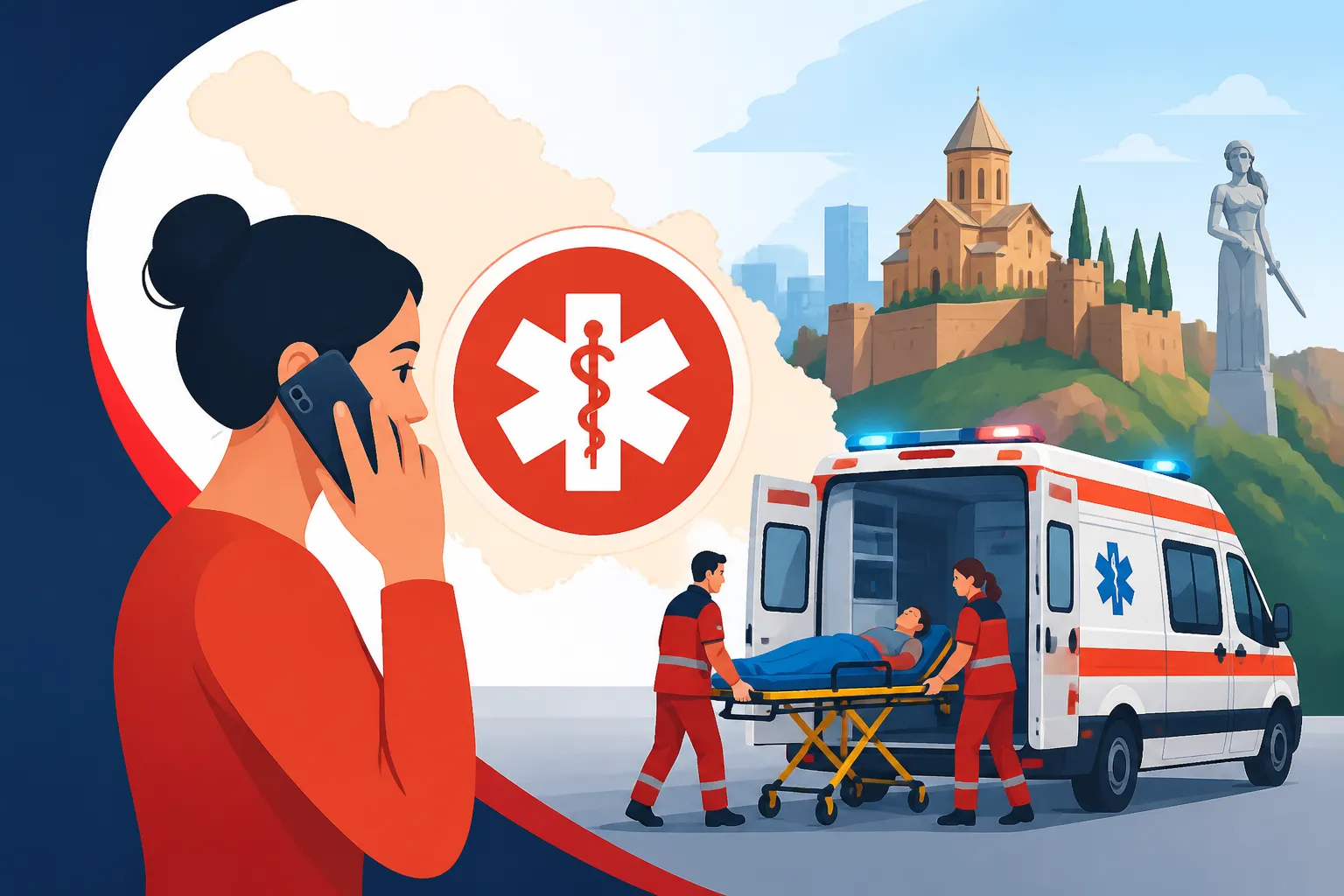
When the ambulance arrives, you'll typically see a team of medical professionals, usually paramedics or emergency doctors, ready to assess the situation. They will evaluate the patient's condition, provide immediate first aid, and stabilize them as much as possible on the scene. This might involve checking vital signs, administering oxygen, stopping bleeding, or immobilizing injuries.
The crew will then transport the patient to the nearest appropriate hospital. "Appropriate" is the key word here. For critical cases, this will likely be a major state hospital with comprehensive emergency facilities, especially in Tbilisi. In some instances, if the situation is less life-threatening but still requires urgent care, or if you have a known pre-existing condition and a preferred private hospital, the crew might consider taking you there, but their priority is stabilization and rapid transfer to a facility equipped to handle the immediate crisis. The decision is ultimately up to the ambulance crew and their medical judgment.
It’s good to know that while the ambulance service is generally efficient, response times can vary depending on your location. In crowded city centers, they're usually quick, but if you're in a more remote area or during peak traffic, it might take longer. Patience, while difficult, is essential in these moments.
Costs and Coverage for Ambulance Transport
Let’s be absolutely clear on this: if you call 112 for an emergency, the ambulance transport itself is typically free of charge. This is a huge benefit in Georgia’s emergency system. However, this is where the free part often ends for expats. Once you arrive at the hospital, whether it's a state-run facility or a private one, you will likely be responsible for the costs of diagnosis, treatment, medication, and any subsequent hospitalization.
This is precisely why robust private health insurance is not just a recommendation, but a necessity for expats in Georgia. Without it, even a seemingly minor emergency could lead to significant out-of-pocket expenses. This is where providers like SafetyWing really step up. While the ambulance ride is free, your SafetyWing policy, or similar international health insurance, would typically cover the costs of the actual hospital care you receive after the ambulance delivers you. It's crucial to understand this distinction.
Many expats mistakenly believe that because Georgia has a universal healthcare program (UHC), they are fully covered. While some limited services might be available, the UHC generally provides very basic coverage and is primarily geared towards Georgian citizens. Expats, especially those on a visa-free stay or specific residence permits, often find themselves facing the full cost of medical care beyond initial emergency transport. Understanding What Happens If I Get Sick Without Insurance in Georgia? is a sobering but vital read. Having private insurance that covers emergency medical treatment is your best defense against unexpected bills.
Navigating Hospital Care Post-Ambulance
So, the ambulance has done its job, and you (or your loved one) are now at the hospital. This is often where the real administrative and communication challenges begin for expats. It’s a transition from the urgent, immediate care of the paramedics to the more structured, but sometimes bewildering, environment of a Georgian hospital.
Arriving at the Emergency Room
Emergency Rooms (ERs) around the world share a certain chaotic energy, and Georgia is no different. When you arrive, the first step is usually triage. This means medical staff will quickly assess the patient’s condition to determine the severity of the emergency. Patients with life-threatening conditions will be seen immediately, while those with less critical issues might experience longer waiting times. It can be frustrating to wait, but understand that this system ensures the most urgent cases are prioritized.
During the initial registration, you’ll need to provide identification. Have your passport, residence permit (if applicable), and crucially, your private health insurance details ready. If you have a plan like SafetyWing, make sure you have your policy number and the emergency contact information for your insurer. Presenting this information early can smooth the billing process later. While some staff in larger hospitals, especially in Tbilisi, may speak English, don’t count on it as a universal guarantee. Having a phrasebook, a translation app, or ideally, a Georgian-speaking friend or interpreter with you can make a monumental difference during these stressful initial moments. For details on specific facilities, check out our guide on How to Use Major Hospitals and Clinics in Tbilisi.
Treatment and Communication
Once you're through triage, doctors will assess the patient more thoroughly and begin necessary treatment. This often involves diagnostic tests like blood work, urine samples, X-rays, or more advanced imaging such as CT scans. The medical care itself in modern Georgian hospitals, particularly private facilities in Tbilisi, is generally of a good standard, with up-to-date equipment and trained professionals.
However, the communication barrier can still be a significant hurdle. Even if the ER staff or a doctor speaks some English, explaining complex medical symptoms or understanding intricate treatment plans can be difficult. Don't hesitate to ask for clarification, or if possible, request an English-speaking doctor or a translator. It’s vital that you understand what’s happening, what tests are being run, and what the proposed treatment plan is. If you're able, try to advocate for yourself. If not, having a trusted friend or family member who can advocate for you is invaluable. This is a good time to remember that finding an English-speaking doctor in Georgia can be tricky outside of the capital, so proactive research helps. Our guide on How to Find an English-Speaking Doctor in Georgia offers practical advice.
Discharge, Follow-up, and Billing
Eventually, if the condition isn't severe enough for admission, the patient will be discharged. You’ll receive instructions for follow-up care, prescriptions for medication, and advice on recovery. Make sure you understand these instructions clearly before leaving the hospital. Ask about signs to watch for, when to seek further medical attention, and where to get your prescriptions filled. Georgia's pharmacy system is generally efficient, and medications are often quite affordable.
Now, for the inevitable topic of billing. This is where your private health insurance truly proves its worth. State hospitals tend to be more affordable than private ones, but even there, costs can quickly add up for foreigners. Private hospitals, while offering more amenities and often better English-speaking staff, will naturally come with higher price tags. If you have insurance like SafetyWing, you’ll need to understand their claims process. Typically, you’ll pay upfront and then submit a claim for reimbursement. Keep all receipts, medical reports, and any other documentation provided by the hospital. It’s a good idea to contact your insurer as soon as possible after the emergency to understand the specific steps for reimbursement. We have a detailed guide on How to Claim Reimbursement from Private Insurance in Georgia that can walk you through the specifics.
Preparedness: Before an Emergency Strikes
Being prepared is not about being paranoid; it's about being proactive and empowering yourself. While you can't prevent every emergency, you can certainly mitigate the stress and complications if one arises. For expats, this means a bit more groundwork than simply knowing a phone number.
Essential Information to Keep Handy
One of the best things you can do for yourself and your peace of mind is to compile an 'Emergency Kit' of information. This isn't a physical kit, but a digital or paper record of vital details. Keep it accessible on your phone, in your wallet, and perhaps a copy at home. Here’s a rundown of what you should include:
| Item | Details |
|---|---|
| Emergency Number | 112 (Police, Fire, Ambulance) |
| Your Full Address | In Georgian & English (very important for dispatchers) |
| Emergency Contact | Name, Number, Relationship (local & international) |
| Insurance Provider | Policy Number, Contact Info (e.g., SafetyWing, Axa, Geo VHC) |
| Allergies | List all known allergies (medications, foods, etc.) |
| Current Medications | List all regular medications, dosages, and conditions they treat |
| Blood Type | Your blood type (if known) |
| Known Medical Conditions | Diabetes, heart conditions, etc. |
| Passport Number | For identification and hospital registration |
| Residence Permit No. | If applicable, for identification and hospital registration |
Having your address written in Georgian is incredibly useful, as some taxi drivers or even locals you might ask for help from might not recognize the English transliteration. A quick reference on how to get Health Insurance in Georgia: Private and International Options Explained can help you decide which coverage is right for your 'kit'.
Understanding Your Health Insurance Options
This cannot be stressed enough: comprehensive private health insurance is non-negotiable for expats in Georgia. As mentioned, while the ambulance ride via 112 is typically free, the subsequent hospital care is not. Relying solely on the Universal Healthcare Program (UHC) in Georgia is generally insufficient for expats, as it offers limited benefits primarily to Georgian citizens and specific resident categories. Our article on Understanding the Universal Healthcare Program (UHC) in Georgia provides a deeper explanation of its limitations for foreigners.
You have choices between local private insurance providers in Georgia and international plans. International plans like SafetyWing are particularly popular among digital nomads and frequent travelers because they offer global coverage (with some exclusions) and often include travel insurance benefits. This means you’re covered not just in Georgia but also if you travel to neighboring countries. When choosing a plan, look carefully at what it covers for emergency medical treatment, hospitalization, diagnostic tests, and repatriation. Make sure you understand deductibles, co-pays, and the claims process. It's smart to compare options like How to Choose Between Local and International Health Insurance in Georgia. Don't wait for an emergency to learn the hard way; get your coverage sorted out as soon as you settle in.
Learning Basic Georgian Phrases & Local Knowledge
While 112 operators often speak English, and larger private clinics may have English-speaking staff, you simply cannot rely on this in every situation, especially outside of Tbilisi. Learning a few basic Georgian phrases for emergencies can make a huge difference. Words like "help" (damikhmarat), "doctor" (mkharshveli), "emergency" (sasastsrapod), "pain" (tkivili), and "where is…?" (sad aris…?) could be invaluable. Even pointing to the affected area on your body can bridge a communication gap.
Beyond language, familiarize yourself with your immediate surroundings. Know the name of your street, your building number, and a couple of identifiable landmarks nearby. Learn the names and locations of reputable hospitals or clinics in your city. Knowing where these facilities are beforehand can save precious time and reduce panic. Knowing your way around is essential for The Complete Guide to Healthcare in Georgia for Expats (2027) as a whole. Being able to direct a taxi or even walk to a nearby clinic for a less urgent issue is a practical skill for any expat.
Scenarios and Practical Tips
The beauty of living abroad is often in adapting to the unexpected, but when it comes to emergencies, being prepared beats improvisation any day. Let’s look at a few practical scenarios and tips that can help you navigate common situations.
Medical Emergencies on the Road
Imagine you're exploring the stunning Georgian countryside, perhaps driving through the Kakheti wine region, and suddenly, an accident occurs. Your first instinct, and the correct one, should be to call 112 immediately. Keep in mind that response times may be longer outside of major urban centers due to greater distances and sometimes less developed infrastructure. This isn't unique to Georgia; it's a reality in many rural areas globally.
If you’re involved in a vehicle accident, first ensure your vehicle is safely positioned, if possible, to prevent further incidents. Turn on your hazard lights. If there are injuries, prioritize them. When speaking to the 112 operator, be extra precise about your location. Mention road numbers, names of nearby villages or towns, or any prominent natural features. Keeping a basic first-aid kit in your car is always a smart move, containing essentials like bandages, antiseptic wipes, and pain relievers. Also, consider having a local SIM card with some credit so you’re always connected. If you drive in Georgia, knowing your legal rights and responsibilities is important, which you can learn about in Driving in Georgia: Licences, Registration and Rules for Expats (2027).
Non-Life-Threatening Medical Issues
Not every medical problem warrants an ambulance. For non-life-threatening issues like a high fever, a nasty cut that needs stitches, or a sudden severe stomach ache that isn't immediately critical, calling 112 might not be the most appropriate first step. Instead, you'll want to seek out a general practitioner or a walk-in clinic (often called a "polyclinic" in the post-Soviet context).
Many larger cities, especially Tbilisi and Batumi, have private clinics with English-speaking staff that cater specifically to expats. You can often schedule an appointment relatively quickly, or even walk in for urgent care. For minor ailments, a local pharmacy might also be able to offer advice or provide over-the-counter remedies. It's wise to research a few reputable clinics and doctors in your area before you need them. Our guide on Public vs Private Healthcare in Georgia: What Expats Need to Know can help you decide where to seek care. Additionally, many modern insurance plans, including SafetyWing, offer telehealth or remote doctor consultation services, which can be an excellent first point of contact for non-emergencies and allow you to speak with an English-speaking doctor from the comfort of your home.
Dealing with Language Barriers in Stressful Situations
The language barrier is arguably one of the biggest challenges an expat faces during an emergency. Even if you've learned some Georgian, the stress of a medical crisis can make it difficult to recall phrases, and understanding complex medical terminology is another hurdle entirely.
Technology can be your friend here. A good translation app on your phone, such as Google Translate with its conversational mode, can be incredibly helpful for basic communication. However, it's not foolproof for nuanced medical discussions. This is why having a Georgian friend or colleague on speed dial who you can quickly call and put on speaker to interpret can be a lifesaver.
Remember, the 112 operator is your first line of defense against the language barrier. They are trained to handle emergency calls in multiple languages. Once paramedics or doctors arrive, if direct communication is difficult, don't be afraid to use simple gestures, point to areas of pain, or use basic English words. Most medical professionals are used to treating foreign patients and will do their best to understand you, even if communication is imperfect. The priority is your health and safety, and they will usually find a way to get the necessary information. It’s also incredibly useful to have your basic medical information written down, as discussed earlier, so you can simply present that if speaking becomes too difficult.
Disclaimer
The information provided in this article is intended for general guidance and informational purposes only, and does not constitute medical, legal, or professional advice. While we strive to provide accurate and up-to-date information, circumstances can change rapidly. Always consult with qualified medical professionals, legal experts, or your insurance provider for advice tailored to your specific situation. Reliance on any information in this article is solely at your own risk.